Key takeaways
- The age of your home is a good clue to what's underground, but many lines are mixed after past repairs.
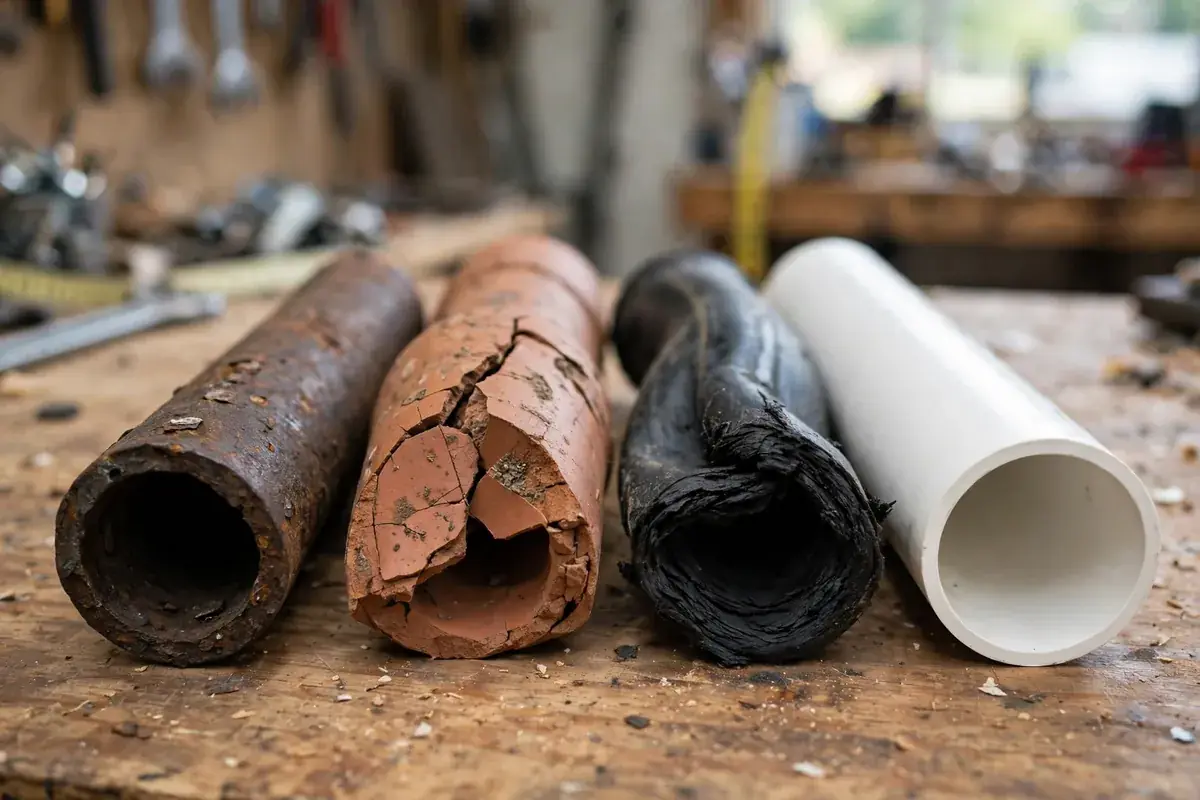
- Clay fails at joints and from cracks; cast iron corrodes from inside; Orangeburg deforms over time.
- Orangeburg usually calls for replacement; sound clay and cast iron are often candidates for lining.
- Only a camera inspection confirms what you have and its condition.
Connecticut has some of the oldest housing stock in the country, and the pipe under the lawn is usually as old as the house. Knowing what material you probably have helps you understand the risks and the options.
Vitrified clay
Common in: many homes built before the 1970s, especially older city neighborhoods.
Strengths: resistant to corrosion and chemicals.
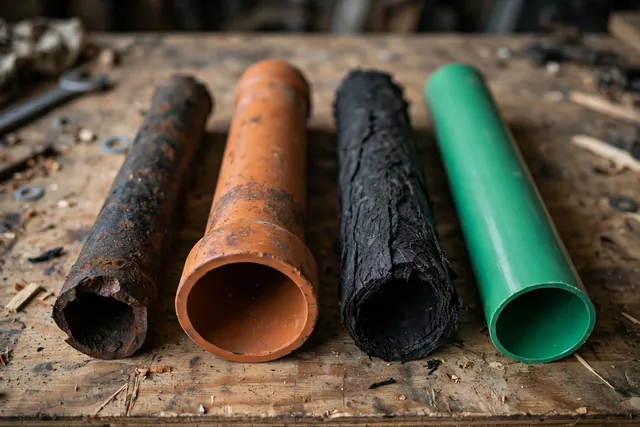
Weaknesses: short sections with many joints — older joints were often mortar or simple packing — so roots and groundwater get in. Clay is also brittle and can crack from soil movement or heavy loads.
Cast iron
Common in: building drains inside the house and some laterals, especially in older homes.
Strengths: strong and quiet.
Weaknesses: corrodes from the inside over decades, building up scale that narrows the pipe and eventually cracking or rotting through along the bottom.
Orangeburg
Common in: homes from the post-war building boom through about the early 1970s.
What it is: bituminous fiber pipe — wood pulp and pitch.
Weaknesses: softens, blisters and deforms into an oval over time, especially under soil load and moisture. Many Orangeburg lines are at or past the end of their service life. Replacement is generally recommended rather than repair.
PVC and ABS plastic
Common in: newer homes and replacement lines.
Strengths: long, smooth sections with tight glued joints; resistant to roots and corrosion.
Weaknesses: can sag if the bedding wasn't done well, and can crack under poor installation.
Matching age to material
| When the house was built | Lateral may be |
|---|---|
| Before about 1945 | Clay or cast iron |
| About 1945–1972 | Clay, cast iron or Orangeburg |
| 1970s onward | Increasingly PVC or ABS |
This is a rule of thumb. Lines are often partly replaced over the years, so one lateral can include two or three materials. The only way to know is a camera inspection.
What to do with this information
Failure patterns by material
| Material | How it typically fails | What you might notice | Common fix |
|---|---|---|---|
| Vitrified clay | Roots at joints, cracks, offset joints | Recurring backups, root-filled cleanings | Spot repair or lining |
| Cast iron | Internal scale, cracks, rot along the bottom | Slow drains, flakes on the cable, leaks under slabs | Descaling and lining, or replacement |
| Orangeburg | Blistering, flattening, collapse | Gradually slower drains, sudden stoppage | Replacement (often bursting or open trench) |
| PVC / ABS | Sags from poor bedding, cracked fittings | Standing water on camera, localized clogs | Spot repair or re-bedding |
| Transite (asbestos-cement) | Cracking and deterioration with age | Varies | Specialized handling; consult a qualified contractor |
Clues you can check yourself
- Look where the drain leaves the house. In the basement, the main drain often exits through the foundation wall or floor. Black or rusty metal is likely cast iron; white or black plastic means at least that section has been replaced.
- Check the cleanout. Its material can hint at the building drain's, though not necessarily the lateral beyond it.
- Ask the town. Some building departments or sewer authorities keep permit records showing when a lateral was installed or replaced.
- Read old disclosures. Past sales paperwork may mention sewer repairs.
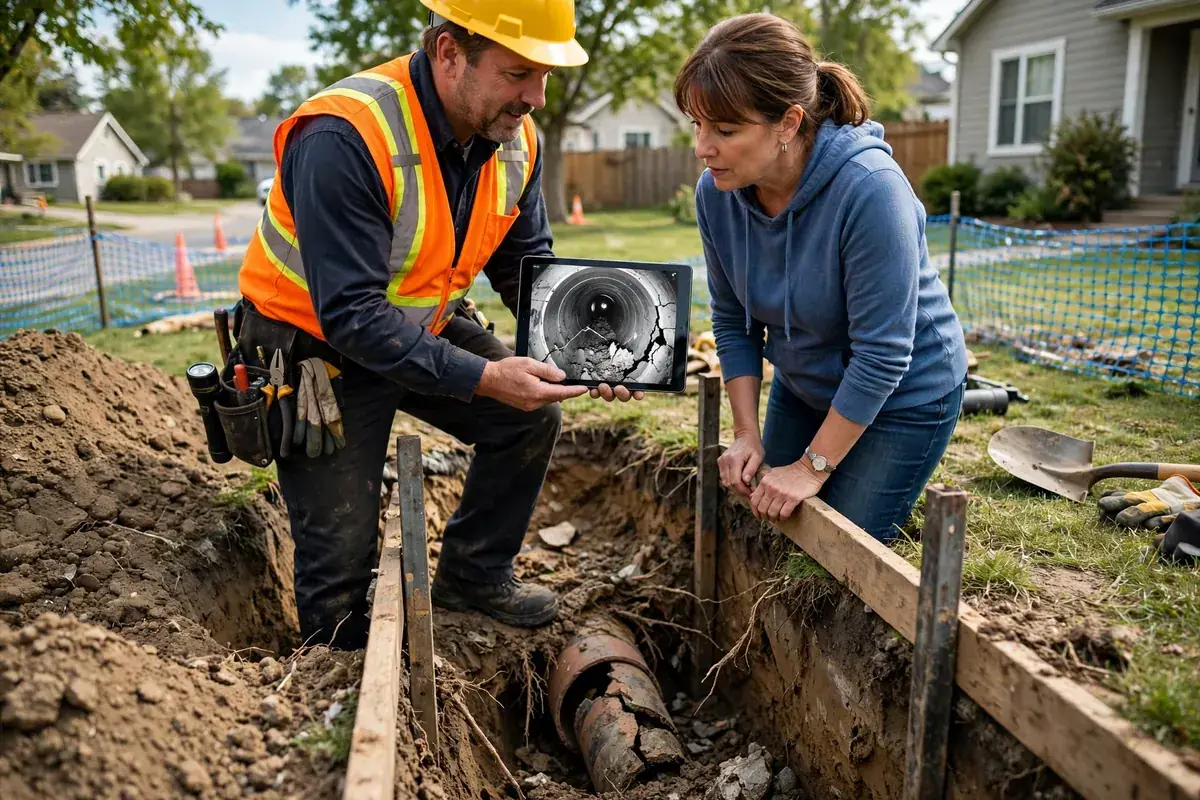
None of these tell you what the pipe looks like 30 feet under the lawn. A camera inspection does.
Why Connecticut has so much old pipe underground
Connecticut's cities grew rapidly in the industrial era, and neighborhoods in places like Hartford, New Haven, Waterbury, New Britain and Bridgeport-area towns were largely built out in the late 1800s and early 1900s. A second wave of building after World War II created the suburbs ringing those cities — the period when Orangeburg was widely used. Many of those original laterals are still in service today, decades past the point where problems become common.
What to do if your camera finds Orangeburg
- Don't panic, but don't wait for a collapse. Plan the replacement rather than reacting to an emergency.
- Ask how much of the line is Orangeburg. Sometimes only part was installed with it.
- Get quotes for bursting and open-trench replacement. Lining usually isn't suitable for deformed Orangeburg.
- Coordinate with other projects. If you're planning a driveway, patio or landscaping, replace the line first.
Mixed lines: the most common reality
Many laterals in older homes are a patchwork: cast iron from the house to just outside the foundation, original clay under the yard, a section of PVC from a past spot repair, and clay again to the main. Each transition is a potential weak point, especially where different materials are joined. A good inspection report notes every change in material and its distance from the access point.
If your home is old and you've never had the line inspected, it's worth doing — especially before buying, renovating or landscaping. If the camera finds Orangeburg or widespread damage, read about sewer line replacement; if the pipe is cracked but round, trenchless lining may be an option. To talk it through, call (855) 554-1144 to reach a local contractor experienced in sewer line repair across Connecticut.
Quick answers
How can I tell if I have Orangeburg pipe?
A camera inspection is the reliable way. On screen, Orangeburg typically looks black, layered or blistered, and often oval rather than round.
Can old clay pipe be lined?
Often, yes — if it still holds its shape and doesn't have long sags. Cleaning and a camera inspection come first.
Is cast iron better than clay?
Each has strengths and weaknesses. Cast iron is strong but corrodes over decades; clay resists corrosion but is vulnerable at joints. Condition matters more than material.
Should I replace an old pipe that isn't causing problems?
Not necessarily. A camera inspection can show whether it has years of service left. Orangeburg is the main exception many contractors recommend planning to replace.
What pipe is used for new sewer lines today?
PVC is the most common material for new residential laterals, with HDPE used for pipe bursting. Local codes determine what's approved.
Have a sewer problem right now?
Call (855) 554-1144 to connect with an independent local contractor for sewer line repair in Connecticut.
This guide is general information, not a professional assessment of your property. Local rules, permits and responsibilities vary by town and sewer authority.