Key takeaways
- One defect in otherwise sound pipe is usually a spot repair.
- Many cracks or root entries in pipe that still holds its shape often point to lining.
- Orangeburg, long sags, collapses and repeat failures usually point to replacement.
- Compare written scopes based on the same camera footage, not just totals.
Once a camera has found a problem in your sewer line, the big question is whether to repair the bad section or replace the line. There isn't a universal answer, but there is a sensible way to decide — and it starts with what the camera actually showed.
Start with the footage, not the quote
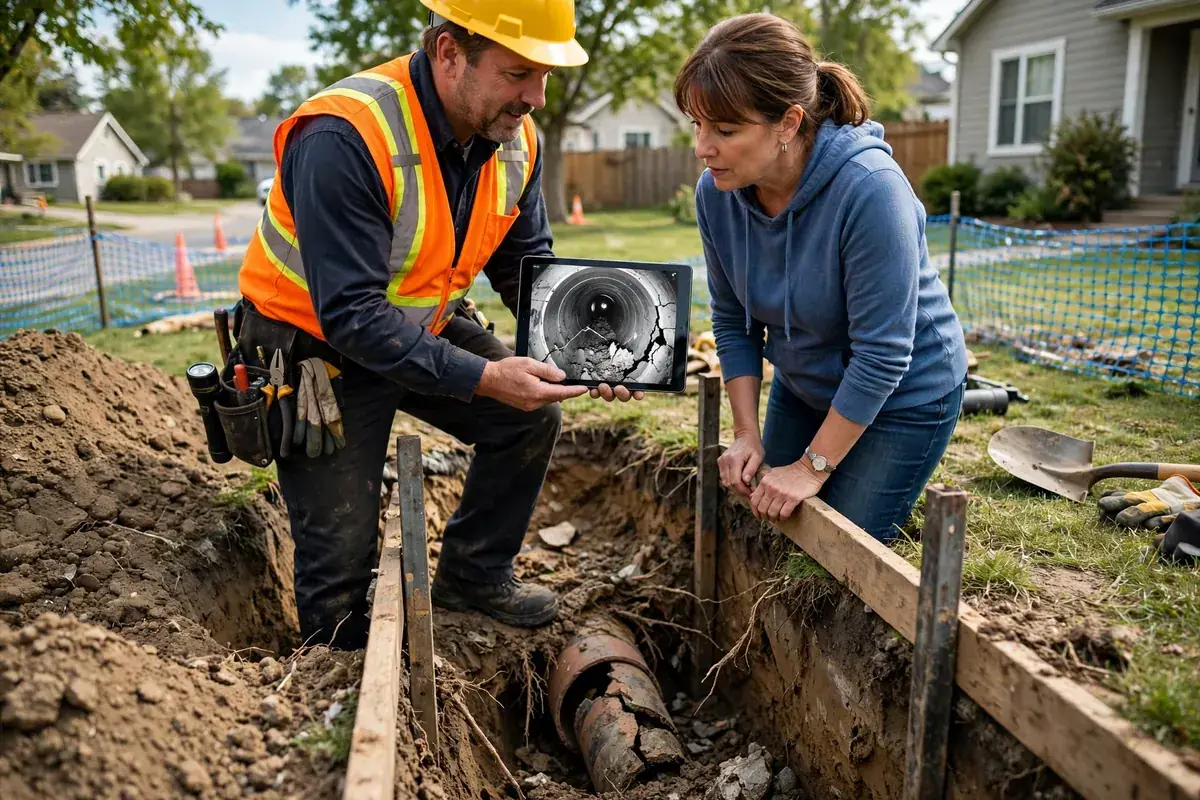
Ask the contractor to walk you through the video and mark each defect: where it is, how far from the cleanout, how deep, and what kind of defect it is. Ask for a copy. Every option below depends on those details. If you haven't had a camera inspection, that's step one.
When a spot repair makes sense
- There's one defect (or two close together) — a cracked section, one offset joint, a single root entry point.
- The rest of the pipe is in good condition on camera.
- The pipe material isn't Orangeburg.
- The defect is somewhere you can dig — not under a foundation, porch or mature tree.
A spot repair removes the damaged piece and replaces it with new pipe joined by shielded couplings. It's targeted and often the least expensive fix.
When lining makes sense
- There are multiple cracks or root entries along the line.
- The pipe still holds its shape — no collapse, no long sag.
- The line runs under something you don't want to dig up.
Cured-in-place lining creates a new pipe inside the old one. Learn more in pipe lining vs. pipe bursting.
When replacement makes sense
- The pipe is Orangeburg, or clay/cast iron failing along most of its length.
- There's a belly (sag) that holds water — lining can't fix slope.
- There's a collapse.
- You've already paid for repeated repairs.
Replacement can be open-trench or by pipe bursting — see sewer line replacement.
A quick comparison
| Spot repair | Lining | Replacement | |
|---|---|---|---|
| Fixes one defect | ✔ | ✔ | ✔ |
| Fixes many defects | — | ✔ | ✔ |
| Fixes a sag | Sometimes (if the sag is the section dug) | — | ✔ |
| Fixes a collapse | ✔ (if local) | — | ✔ |
| Digging | One hole | Little or none | Trench or two pits |
| Rest of old pipe remains | Yes | Encased | No |
Questions to ask before you sign
- What exactly is wrong, and where? Can I see it on the video?
- What happens to the rest of the line if we only fix this spot?
- Which method, which pipe or liner material, and how many feet?
- Who pulls the permits, and what inspections are required in my town?
- What restoration is included?
- What warranty applies to the work and materials?
- Is your plumbing license current? (Connecticut plumbing licenses can be checked through the state's Department of Consumer Protection eLicense lookup.)
Don't forget the connection at the main
Some lines fail where the lateral meets the street main. That section may sit under the road, involve a street opening permit, and — depending on your town — be the owner's or the town's responsibility. See who is responsible for the sewer lateral in Connecticut.
A decision checklist you can use with any contractor
- What material is the pipe? Orangeburg tips the decision toward replacement almost on its own.
- How many defects, and how far apart? One or two close together favors a spot repair. Defects spread along the line favor lining or replacement.
- Is the pipe still round? If yes, lining is on the table. If it's crushed, deformed or collapsed, it isn't.
- Is there a sag? Lining can't change slope. A belly needs excavation of that section.
- What's on top of the line? Driveways, patios, porches, mature trees and finished landscaping make trenchless methods more valuable.
- What's the ground like? Ledge, boulders and high groundwater make digging slower and more costly.
- What's the history? If you've already paid for repairs on this line, the next one may be the time to replace it.
Three common scenarios
Scenario 1: one root-filled joint, 30 feet out
The camera shows clean, round clay pipe except for one joint with root intrusion and a small crack. A spot repair — or a short sectional liner if the spot is under a driveway — usually makes sense. Replacing the whole line would be hard to justify.
Scenario 2: roots at a dozen joints, pipe still round
The line is old clay with roots entering at many joints but no sags or collapses. Fixing each joint by excavation would mean many holes. Full-length lining often fits this pattern well.
Scenario 3: Orangeburg with a long belly
The camera shows black fiber pipe flattening into an oval, plus a 15-foot sag holding water. Lining isn't an option, and spot repairs would just chase the next failure. Replacement — open-trench or pipe bursting — is the realistic answer.
How to compare quotes fairly
Two quotes can look wildly different simply because they describe different work. Before comparing prices, make sure each written scope covers:
- The method (spot repair, lining, bursting, open trench) and the length treated
- Pipe or liner material and diameter
- New cleanouts, if any
- What happens at the connection to the main or septic tank
- Permits, inspections and any street opening work
- Surface restoration — loam and seed, paving, walkway reset
- Warranty terms for workmanship and materials
- A final camera inspection of the finished work
Sharing the same camera video with every contractor you ask is the simplest way to make sure everyone is pricing the same problem.
Timing: should you fix it now or wait?
Some defects can safely be monitored — a small crack with no roots and no sag, for example. Others tend to get worse quickly: active root intrusion, offset joints that are catching waste, or soil visible through the pipe wall. Ask the contractor directly what happens if you wait six months, and what signs would mean it can't wait. If you're planning landscaping, a new driveway or a sale, fixing the line first usually avoids paying to undo new work later.
If you're weighing options now, call (855) 554-1144. We'll connect you with a local contractor who handles sewer line repair across Connecticut and can lay out each option for your line.
Quick answers
Is it worth getting a second opinion?
For large jobs, yes. Share the same camera footage with each contractor so you're comparing like for like.
Does replacing the sewer line add value to a home?
A documented new sewer line can be a selling point and may remove a common inspection concern, particularly for older homes.
Can I replace just part of my sewer line?
Yes. Partial replacement is common when one section has failed and the rest is sound. A camera inspection shows where the transition should be.
Is lining considered a repair or a replacement?
It's often called trenchless rehabilitation — the old pipe stays in place, but the liner forms a new, structural pipe inside it.
How long does a spot repair take?
Many spot repairs are completed in a day, though permits, ledge, depth and inspection scheduling can affect timing.
Have a sewer problem right now?
Call (855) 554-1144 to connect with an independent local contractor for sewer line repair in Connecticut.
This guide is general information, not a professional assessment of your property. Local rules, permits and responsibilities vary by town and sewer authority.